The other day, my friend Pamela told me that she is reading Stephen Jay Gould's The Mismeasure of Man for one of her classes. I thought I had read it, but it turns out the book I actually read was Carl Sagan's The Dragons of Eden. My confusion was because the books covered similar topics (the evolution of human intelligence) and were published close in time.
I confess, I am kind of a science geek. I read science magazines, newspaper articles and books with great interest. Recently, I read the nearly 600 page biography of Einstein by Walter Isaacson. It was totally riveting, both the personal and the science. What Issacson's book does well is show how scientific knowledge (and the pursuit of it) fits into the broader context of history and culture. Einstein's theories literally changed the world. They ushered in the atomic age and shifted our understanding of the basic laws of nature. The thing that people don't remember is that he spent decades in a fruitless quest for a grand unified theory bridging the very large (cosmology) and the very small (quantum physics). That quest still continues by others. He also rejected much of the new physics that followed his revolutionary ideas of the first two decades of the 20th century. He was a true celebrity in the way that say a Bill Clinton is. He attracted a crowd wherever he went and people clambered to hear him speak.
Carl Sagan was like that for me when I was a teenager. His books, and particularly, his TV show Cosmos really opened my eyes to the wonder of the universe and helped me become a critical thinker. Sagan really showed me the romantic nature of science. My other hero during these years was Arthur C. Clarke, the science fiction writer. When I was 15 years old, I joined an organization called the Planetary Society. All you had to due was pay annual dues, and you were in. One day, they sponsored a lecture by Carl Sagan. My mon and I attended the lecture. Seated in the front row was none other that Arthur C. Clarke. The man lived in Sri Lanka, but here he was in NYC, not but 50 feet away. Before the lecture started, many of the audience members queued up and got Mr. Clarke's autograph. I didn't have anything for him to sign, so I did not get in the line. I have always wished that I would have gotten in line and simply shaken his hand and thanked him for all the great stories. You don't often get a chance to thank your heroes, and to this day, I wish I had. Isaac Asimov was there too, but I didn't care about him in those days.
Tuesday, August 10, 2010


Thursday, July 22, 2010
The Young Adult Novel
I host an annual book discussion at the local community garden where I volunteer. This year, I decided to pick The Hunger Games by Suzanne Collins. This is a young adult novel that is all the range among the tween set and beyond. I think many adults are put off by the young adult novel, but they can be great books that are enjoyed by all ages. For example, I recently reread A Wrinkle in Time by Medeline L'Engle. I would rate that a great novel without qualification.
The Hunger Games presents a post-apocalyptic future where the country is divided into a number of districts. Each district has to put forth children to do battle in a gladiator ring. The plot points and the themes are totally up my alley. My hope for this novel is that, like Animal Farm or Lord of the Flies, the conceit of the plot is merely a launching pad to explore deeper truths. We shall see whether this novel is simply this year's fad, or whether it resonates enough to be remebered and read by future generations. Stay tuned.
Sunday, July 11, 2010
Gilead
On Saturday, I finished reading Gilead by Marilynne Robinson. The novel takes place in 1956 in a small town in Iowa. The conceit of the book is that it is a long letter written by a 76 year old Calvinist pastor (John Ames) to his young son. John Ames is in the last stages of heart disease and will not be around to teach his son the moral lessons that a father would impart to a child over time. In the letter, written over a period of several weeks, Ames writes to his son about his own family history. Ames' grandfather, a young man living in Maine in the 1830s, had a vision of Christ bound in chains. He decided to move to Kansas, which was still a territory, in order to fight for Kansas' admittance into the Union as a free state. Ames' grandfather's tactics in the support of abolition includes violence. This is a hell of a thing, considering that the grandfather is a preacher himself. Ames' letter to his son continues the story of his grandfather, his father and that of his best friend's wayard son, who has returned home after being away for many years. The book is a lyrical exploration of the concepts of forgiveness, faith and grace. The story of the prodigal son permeates throughout the book.
When Ames sets to telling the story of his family, the book is really engaging. However, the more philosophical musings can bog down the reading. This is not a quick read, but it is worthwhile.
Thursday, June 17, 2010
Birthday Reflections
I just added about two thousand pages to the great unread collection of books that I hope to eventually get to. This week, I completed another revolution around the sun. In recognition of this, Amy presented me with two books: 1) Christianity, The First Three Thousand Years by Diarmaid MacCulloch and 2) 2666 by Roberto Bolano. I am very excited to receive these books. The Christianity book was favorably reviewed in the NY Times Book Review section. The history of Christianity is essentially the history of western civilization. There are serious gaps in my historical knowledge that I am interested in discovering: what was it like for the early Christians to be persecuted by the Romans? What led to the schism between the eastern and western churches? What specifically happened during the crusades? These issues are relevant today as we see people of faith being persecuted around the world and we see people of faith practicing intolerance and persecution. This book will likely sit on my bedside table and take a while to finish. I have to finish the other book on my bedside first, The Cuba Reader. As for 2666 (see my post from April), I am really looking forward to reading this novel. I will start it immediately after finishing Gilead (and Hyperion and The Lost Symbol).
I have come to the point in my life where I realize that I will not be able to read all the books that I plan to. There is a serious backlog of books I want to read and I keep adding to it. But that's OK. I am simply going to focus on enjoying the books that I do read. It's not like I win a prize at the end. That being said, I want to make every choice count. If I am not enjoying a book, I will drop it and move on.
Tuesday, June 8, 2010
Dan Brown, (Not So) Guilty Pleasure
About 5 years ago, I started a book club at work with the idea that we would read bestsellers of the potboiler variety. I had been in a book club that read a lot of different things, but most of what we read was literary/artsy/highbrow. I wanted to read books that were similar to the types of books that were popular when I was a kid: Jaws, The Godfather, The Boys from Brazil, Looking for Mr. Goodbar; books that didn't necessarily have anything profound to say, but were riveting pageturners.
The first selection for this office book club was The DaVinci Code by Dan Brown. This was the most popular book on the planet at the time. Everyone had read it or was reading it. Is there anyone who hasn't read it? The story is bereft of any kind of literary ambitions, but boy what a hell of a ride! The story grabs you from the first chapter and doesn't let go. It is a masterful blend of history / religion / suspense / mystery. Yes, it almost reads like a movie, and, incidentally, it was much better than the movie version that later came out.
Alas, the great potboiler experiment did not last. The next office book club selection was The Kite Runner. No one wanted to read John Grisham or Sara Paretsky. We had reentered the world of deep characters and emotional journeys. Oprah would have been proud. However, this didn't stop me from reading Angels and Demons on my own. This book was published before The DaVinci Code and is better. It was even more suspenseful and quicker paced. The movie was mediocre (why are the movie versions of these terrific books so average?) Right now, I am in the early part of The Lost Symbol, the third in Dan Brown's Robert Langdon series. I totally think of Tom Hanks as the protagonist as I turn the pages.
Often, when I reflect on what I like about certain writers or books, I point to the prose style or the development of the characters. Sometimes the stories give me new insights on life. I am often enriched by the great books that I read. However, what I enjoy about these Dan Brown novels is that I am always thoroughly entertained, even if I am not edified. But that is ok. I can always read Umberto Ecco (Dan Brown's literary counterpart) for that.
Saturday, May 29, 2010
Every Painting Tells a Story Don't It

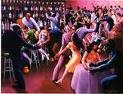
...well perhaps every painting does not tell a story, but many do. I recently visited the Art Institute of Chicago. A long time ago I figured out that the best way to experience the "Toot" is to try to see a little bit during each visit. The collections are so expansive and varied that trying to take it all in at once is impossible and leads to burnout. My best experiences at the Toot have been when I have popped in for a couple of hours and have focused on no more that two or three areas. Every time I go, I discover something new or see something again with a fresh perspective.
On my most recent visit I discovered the artist Archibald Motley. He was part of the Harlem Renaissance and was known for his paintings of African American nightlife. In fact, the painting that caught my attention is titled "Nightlife". The museum caption for this painting lauds Motley's use of color and artificial light. The caption compares Motley's use of light in Nightlife to another painting located in the next room, Edward Hopper's iconic "Nighthawks". What drew me into both of these paintings were the scenes themselves. Both of these paintings are inhabited with strong characters and suggested stories. Look at the scene at the bar in Nightlife. There are two women sitting at the bar dressed to kill and having a smoke. One of the women is looking intenesly at a man standing a few feet away, who, in turn, is looking away from the woman and has his arm outstretched towards another woman who is dancing with another man. The woman at the bar is looking at the man with what may be described as exacerbation or intense annoyance. Maybe he is her man who is trying to make time with another woman. Maybe she is obsessed with the man who doesn't even know how she feels. Towards the middle of the painting there is another man sitting alone at a table, smoking and having a drink with his eyes closed. He is surrounded by people dancing and in happy revelry. He looks like the saddest and loneliest person in the word. He may have lost someone close and dear to him through some foolish action of his.
Nighthawks presents 4 people at a diner late at night. A man and a woman sit together; another man sits away from them with his back to the viewer; the diner employee looks like he is preparing something or putting something away. It is unclear if the characters are acquainted with each other, but there is definitely a tension in the scene. The couple may be on the verge of a split or maybe they are just bored with each other. Does the mysterious third diner patron bear them any ill will? Is the employee part of their lives in some way?
Unlike reading a text narrative, these type of paintings allow the viewer to construct his own story within the context of the scene presented by the artist.
Tuesday, May 25, 2010
Magazines and Wilson
Amy and I receive a slew of magazines. Some are weekly, biweekly, monthly and quarterly. This is in addition to a daily newspaper. Aside from contributing to global deforestation (I still like the physical copy versus the on-line versions), the magazines present a lot of text for me to read in addition to the books that I read. I enjoy reading magazines (mostly of the non-fiction variety) in a different way that I enjoy reading books. Magazines, with their glossy photos and snappy text layouts, are often inviting to read, but do not compel me to keep around for any long period of time. In fact, my rule of thumb is that I only keep a particular magazine around until the next issue arrives. I them pass it along to a friend or recycle. If I didn't get around to reading the magazine, too bad. I get rid of it and move on to the next issue. This helps me manage the pile-up of unread material. There are enough books that I want to get to before I turn to dust. The last thing I need is having to make time to read the Time Magazine cover story about Afghanistan from March that I never got to. If I really want to read it, I have a whole week to find the time.
A friend of mine takes a different approach. She keeps the zines around so that she has more choices when she has the time to read. I guess I am hard-wired differently. I can be a lazy reader. If I did not impose the deadlines on myself, the zines would pile up. What my friend views as having more choices by keeping old zines around, I would view with a creeping anxiety as the piles of unread material gets larger.
On a different note, I just read Daniel Clowes latest graphic novel, Wilson. My friend Jimmy loaned it to me. This is the first book that Clowes has written which did not originally appear in one of his comic books. In other words, the material was first published graphic book format. Clowes is at the top of his game. He has really matured from his early punkier days. Wilson is a middle aged man living in Oakland who has no real connections with other human beings. He tries very hard to force square pegs into round holes and the results are hilarious and depressing. Kudos to Clowes for hitting one out of the ballpark. My only regret is that I read the whole thing in about an hour. Thanks Jimmy!
Subscribe to:
Posts (Atom)